
The Question Everyone’s Asking in 2026
If you’re reading this, you’ve probably heard the buzz. Your CTO mentioned it. Your developer friend won’t stop talking about it. Even your cousin asked at Thanksgiving: “Should I use OpenClaw or Claude Code?”
By 2026, this isn’t just a tech insider debate anymore. It’s a real business decision. Companies are choosing where to invest their AI budget. Developers are deciding which tool goes into their daily workflow. Non-programmers are looking to automate their lives.
I spent the last three months testing both tools in real scenarios — not demo videos, not marketing slides. I used Thunderbit to scrape forum discussions, talked to teams who bet their workflows on these platforms, and ran my own hands-on tests. If you’re tired of marketing fluff and want data-driven, practical advice, this guide is for you.
Let’s cut through the noise, bust the myths, and help you make the smart choice for your team, your tech stack, and your productivity in 2026.
The Biggest Myth: They’re Not Actually Competitors
Here’s the first thing you need to understand: OpenClaw and Claude Code are not direct competitors.
Yes, they both use AI. Yes, they both have passionate communities. Yes, they’re both hot topics in 2026. But they solve completely different problems.
Think of it this way: OpenClaw is like hiring a personal assistant who never sleeps. Claude Code is like hiring a senior developer who sits next to you and writes code.
What Is OpenClaw?
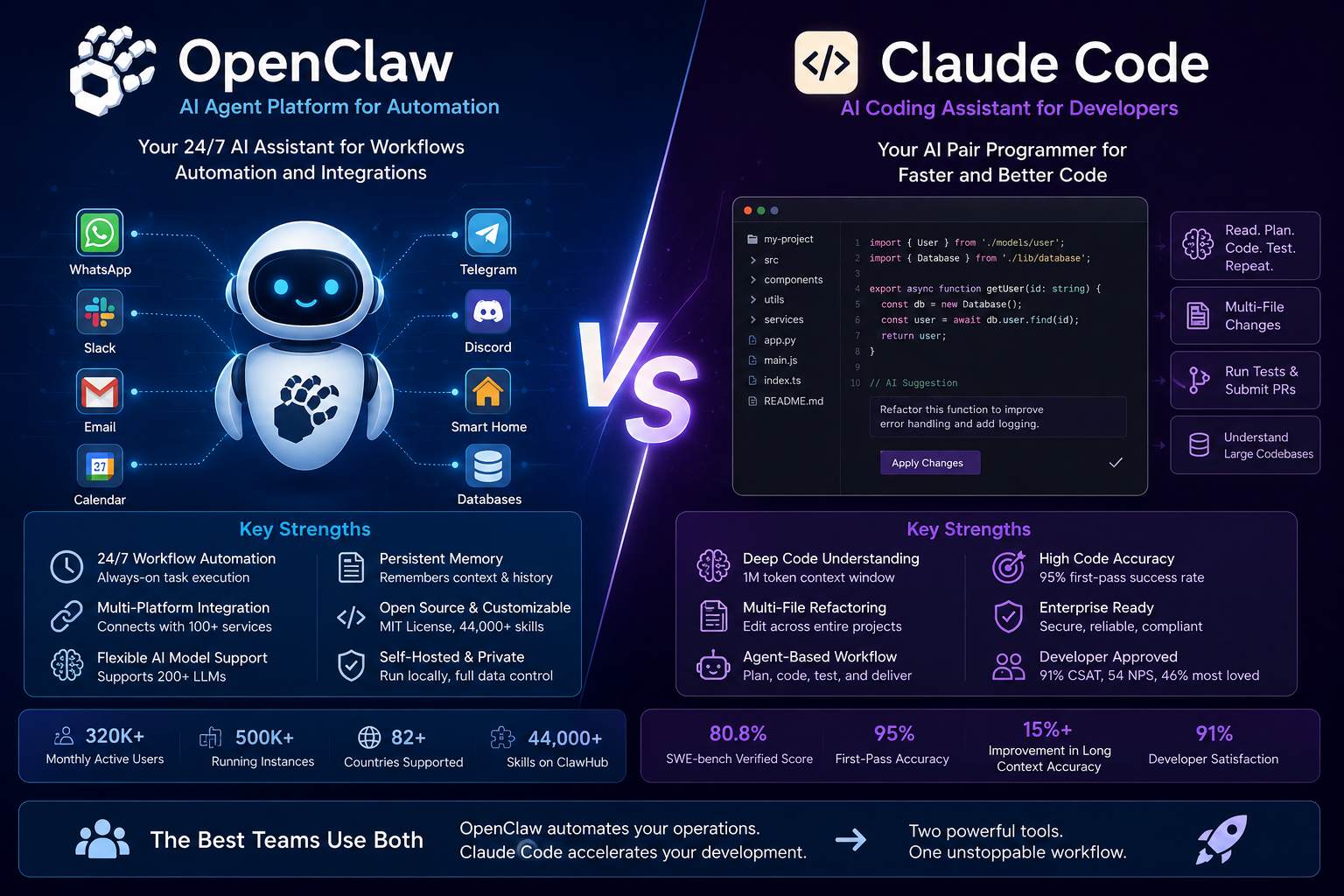
OpenClaw is a general-purpose, open-source AI Agent platform. It’s designed to automate your digital life and work — not just answer questions, but actually do things for you.
With OpenClaw, you can:
-
Manage emails automatically
-
Schedule meetings and calendar events
-
Control smart home devices
-
Scrape web data
-
Write new “skills” to extend its capabilities
-
Connect to WhatsApp, Slack, Discord, Telegram, Signal, iMessage, email, calendars, music services, and more
It runs 24/7, either locally on your machine or on your own server. It’s built for continuous automation, not one-off tasks.
Key stats:
-
200+ LLM backends supported (Claude, GPT-4o, Gemini, Llama, DeepSeek, local models via Ollama/vLLM)
-
44,000+ skills on ClawHub
-
3.2 million monthly active users
-
500,000+ running instances
-
MIT license (fully open source)
What Is Claude Code?
Claude Code is Anthropic’s intelligent coding tool. It’s built for developers who want an AI partner inside their terminal or IDE.
With Claude Code, you can:
-
Write and refactor code
-
Review pull requests
-
Plan changes across entire code repositories
-
Run tests automatically
-
Submit pull requests
-
Coordinate multi-file changes
It integrates deeply with VS Code, JetBrains, Xcode, and command line. Its focus is software engineering productivity, not general automation.
Key stats:
-
1 million token context window (fits entire monorepos)
-
SWE-bench Verified score: 80.8% (highest among live products in Q1 2026)
-
95% first-pass code correctness in recent developer tests
-
91% CSAT, 54 NPS
-
46% “most loved” rating among developers
Real-World Example: How They Work Together
Imagine a small SaaS company in 2026:
The operations team uses OpenClaw to:
-
Automatically send onboarding emails to new customers
-
Manage customer support tickets
-
Organize Slack channels
-
Monitor server uptime
-
Forward critical alerts to the right people
The development team uses Claude Code to:
-
Refactor the Python backend
-
Review pull requests
-
Coordinate changes across 30+ files
-
Migrate code from Java to Kotlin
-
Run automated tests before deployment
Both tools are critical. Neither replaces the other. The smartest teams in 2026 use both — for completely different jobs.
Core Strengths: Where Each Tool Wins in 2026
OpenClaw: The Automation Engine
OpenClaw shines when you need high-performance, always-on automation. It’s not just for developers. Independent creators, small business owners, smart home enthusiasts, and large enterprises all use it.
Where OpenClaw dominates:
1. 24/7 Workflow Automation OpenClaw doesn’t wait for you to ask. It runs continuously, executing scheduled tasks, routing emails, monitoring servers, and forwarding messages — all without human intervention. Think of it as a cron job on steroids that can also understand natural language.
2. Universal Connectivity If it has an API, OpenClaw probably connects to it. WhatsApp, Slack, Discord, Telegram, Signal, iMessage, email, calendars, Spotify, smart lights, thermostats — you name it. This universal connectivity makes it the central nervous system for your digital life.
3. Model Freedom You’re not locked into one AI provider. OpenClaw supports 200+ LLM backends. Want to use Claude for creative tasks, GPT-4o for reasoning, and a local Llama model for privacy-sensitive work? You can switch between them instantly or even use different models for different skills.
4. Persistent Memory OpenClaw saves context as local Markdown documents. This means your agent “remembers” what it did yesterday, last week, or last month. It builds on previous work instead of starting fresh every time.
5. Open Source and Customizable MIT license means you own it. The community has contributed 44,000+ skills on ClawHub. If something doesn’t exist, you can build it yourself or ask the community.
The China Phenomenon: In China, OpenClaw became an overnight sensation. Developers adapted it for WeChat and other local platforms. Major tech companies like Tencent, Alibaba, and ByteDance use it for server monitoring and intelligent office automation. Demand was so intense that Mac Mini M4s sold out — people bought dedicated hardware just to run OpenClaw agents 24/7.
Claude Code: The Developer’s AI Co-Pilot
Claude Code is built for one thing: making developers write better code faster. Its entire design revolves around software engineering workflows.
Where Claude Code dominates:
- Deep IDE and Terminal Integration Claude Code lives where developers live — in VS Code, JetBrains, Xcode, and the terminal. You don’t switch contexts. You describe what you want, and Claude Code does the heavy lifting while you stay in your flow.
- Agent-Style Workflow This isn’t code completion. Claude Code reads your entire codebase, plans a series of changes, runs tests, and submits PRs. You define the goal and review the plan. The execution loop runs independently.
- Massive Context Window At 1 million tokens, Claude Code can hold entire monorepos in memory. This means it understands dependencies, sees how changes in one file affect another, and coordinates modifications across dozens or hundreds of files.
- Multi-Agent Collaboration The experimental “Agent Teams” feature lets multiple Claude agents work together on complex tasks. Each agent has its own context window and specialty. One might handle database migrations while another updates the API layer.
- Code Review and Refactoring Dedicated agents can analyze, refactor, and review code across dozens of files. This improves code quality while reducing the manual burden on senior developers.
Real Case Study: A fintech company used Claude Code to migrate 1.2 million lines of Java code to Kotlin. The agent coordinated changes across hundreds of files, ran tests, and submitted PRs. Human review time dropped by 92%. Developer productivity increased by 55%. Software quality improved by 31%.
Under the Hood: How They Actually Work
OpenClaw’s Architecture: GPU-Powered Parallel Processing
OpenClaw is built for parallel, high-throughput computing:
Local or Self-Hosted Deployment You control the environment, data, and models. This matters for privacy, compliance, and cost control. Your data never leaves your infrastructure unless you want it to.
GPU Acceleration Whether it’s image processing, simulation, or massive data processing, OpenClaw leverages your machine’s GPU for significant speedups. This makes it ideal for compute-intensive automation tasks.
Model Agnostic Swap LLM backends freely. Use Claude for complex reasoning, GPT-4o for speed, Gemini for multimodal tasks, DeepSeek for cost efficiency, or local models via Ollama/vLLM for complete privacy. No vendor lock-in.
Continuous Autonomous Operation OpenClaw agents stay online indefinitely. They save context as local Markdown documents, forming persistent memory. They can even generate new skills to extend their own capabilities over time.
Claude Code’s Architecture: Advanced Language Reasoning
Claude Code is built for deep language understanding and code reasoning:
Agent-Style Planning It doesn’t just complete code — it reads the entire repository, plans a sequence of actions, and calls real development tools. This is a massive leap beyond traditional code assistants that only suggest the next few lines.
Context Retention With 1 million tokens of context, Claude Code “sees” the whole project. It understands dependency relationships and coordinates changes across many files simultaneously.
Human-in-the-Loop Control You define the goals. You review the plans. You approve the commits. Claude Code handles the grunt work, but you stay in charge. This balance of autonomy and oversight is crucial for production code.
Multi-Agent Teams Experimental “Agent Teams” let multiple Claude agents collaborate. Each agent has its own context and role. They can divide complex tasks and work in parallel, then integrate their results.
Real Example: A SaaS backend team used Claude Code to refactor a legacy Python service. The AI agent coordinated changes across 30+ files, ran tests, and submitted a PR in under an hour — work that previously took a full week.
Security and Reliability: The Trade-Offs
OpenClaw: Freedom vs. Responsibility
OpenClaw’s open-source nature is a double-edged sword.
The Good:
-
Complete transparency — you can audit every line of code
-
No vendor lock-in
-
Community-driven rapid innovation
-
Full control over your data and infrastructure
The Risks:
-
138+ tracked CVEs in just 63 days in early 2026
-
1,467+ malicious skills flagged on ClawHub
-
Security patches depend on community vigilance
-
Enterprises must implement strict governance and regular updates
Bottom line: OpenClaw gives you power and flexibility, but you must actively manage security. It’s like owning a sports car — thrilling, but requires maintenance and responsible driving.
Claude Code: Managed Security for Regulated Industries
Claude Code is hosted by Anthropic with strong security practices.
The Good:
-
Enterprise-grade compliance certifications
-
Professional security team monitoring threats
-
Regular audits and updates
-
Predictable security posture
The Trade-Off:
-
Less flexibility — you can’t modify the core system
-
Data goes to Anthropic’s servers (though they have strong privacy policies)
-
Dependent on Anthropic’s roadmap and pricing
Bottom line: If you work in finance, healthcare, or any regulated industry, Claude Code’s managed security is a major advantage. You get peace of mind, but less control.
Performance Benchmarks: Real Numbers from Real Tests
Data-Intensive Tasks: OpenClaw Leads
In 2026 industry benchmarks, OpenClaw showed significant improvements over 2025:
Table
| Task | Performance vs. Competitors |
|---|---|
| Massive data processing (10TB dataset) | 18% faster than nearest rival |
| Graphics and simulation rendering | 22% faster than traditional automation tools |
| Concurrent automation tasks | Supports 500,000+ simultaneous tasks across 82 countries |
| Active user base | 3.2 million monthly active users |
| Available skills | 44,000+ on ClawHub |
Code Intelligence: Claude Code Dominates
Claude Code excels at understanding context and generating long-form code:
Table
| Metric | Score |
|---|---|
| SWE-bench Verified | 80.8% (highest among live products, Q1 2026) |
| First-pass code correctness | 95% |
| Long-context accuracy improvement (vs. 2025) | +15% |
| Customer Satisfaction (CSAT) | 91% |
| Net Promoter Score (NPS) | 54 |
| “Most loved” among developers | 46% |
The OpenClaw vs. Claude Code debate in 2026 reflects a larger trend: AI tools are becoming specialized. The era of one AI doing everything is ending. Instead, we’re seeing purpose-built AI agents that excel at specific tasks.
OpenClaw represents the future of automation — AI that works continuously in the background, connecting services, and managing workflows.
Claude Code represents the future of augmented development — AI that works alongside humans, handling implementation while humans focus on architecture and decisions.
The question isn’t “which tool is better?” The question is “what do you need to accomplish?” Answer that, and the right tool becomes obvious.
In 2026, the most successful individuals and teams aren’t choosing between OpenClaw and Claude Code. They’re combining them — using each for what it does best, and building workflows that leverage both.
That’s the future of AI productivity. And it’s already here.